Best Seller
The 500+ WHP SEAT Ibiza 1.8T Built to Challenge the Competition
NO LIMITS, NO COMPROMISES
The 500+ WHP SEAT Ibiza 1.8T Built to Challenge the Competition
Forged internals, a Garrett GTX3071, a six-speed manual gearbox, and 500 horsepower at the wheels. Built in Greece, this lightweight SEAT Ibiza proves that serious performance doesn’t necessarily require four driven wheels.
There are builds that follow trends, builds that chase horsepower figures, and then there are builds that exist simply because someone has a very specific vision of what a performance car should be.
This SEAT Ibiza belongs firmly in the third category.
The formula is straightforward, at least on paper: a compact front-wheel-drive hatchback, a heavily modified 1.8-litre 20-valve turbocharged engine, a serious Garrett turbocharger, and a traditional six-speed manual gearbox.
But behind that seemingly simple combination lies an extensive engineering project, where almost every mechanical component has been selected, modified, or manufactured to serve a particular purpose.
The car was built at Zaxariou Autotuning in Liosia, Greece, under the guidance of its owner, George, known from the Car Freaks GR YouTube channel. With significant involvement from Kakarakis Performance, the objective was clear from the beginning: create an extreme front-wheel-drive street car without unnecessary limitations, one that could occasionally visit the drag strip while retaining the character and driving involvement of a manual-transmission car.
There was one requirement that was never open for discussion.
The gearbox had to remain manual.
Everything else could be modified, upgraded, or removed in pursuit of performance.
Understated Looks, Serious Intentions
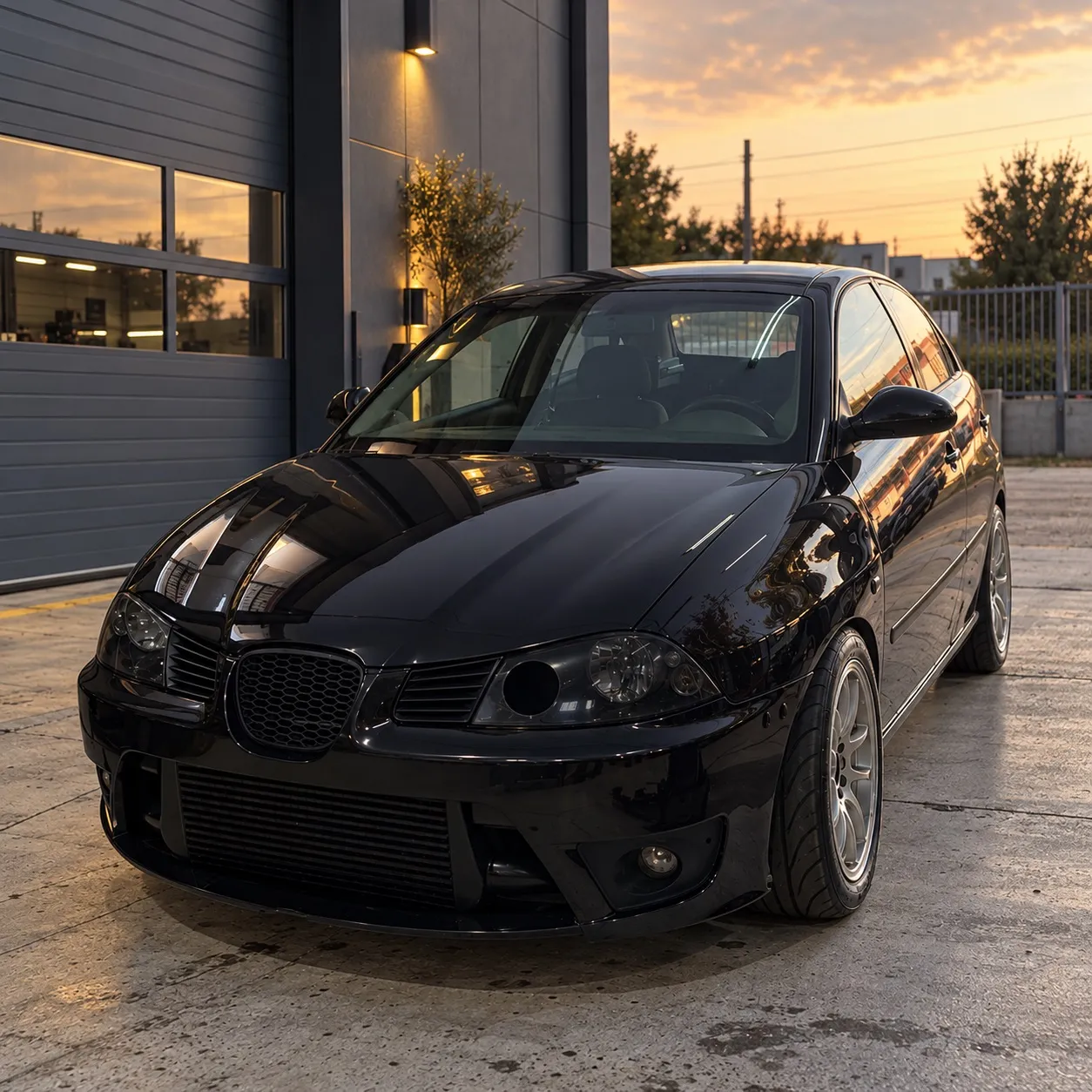
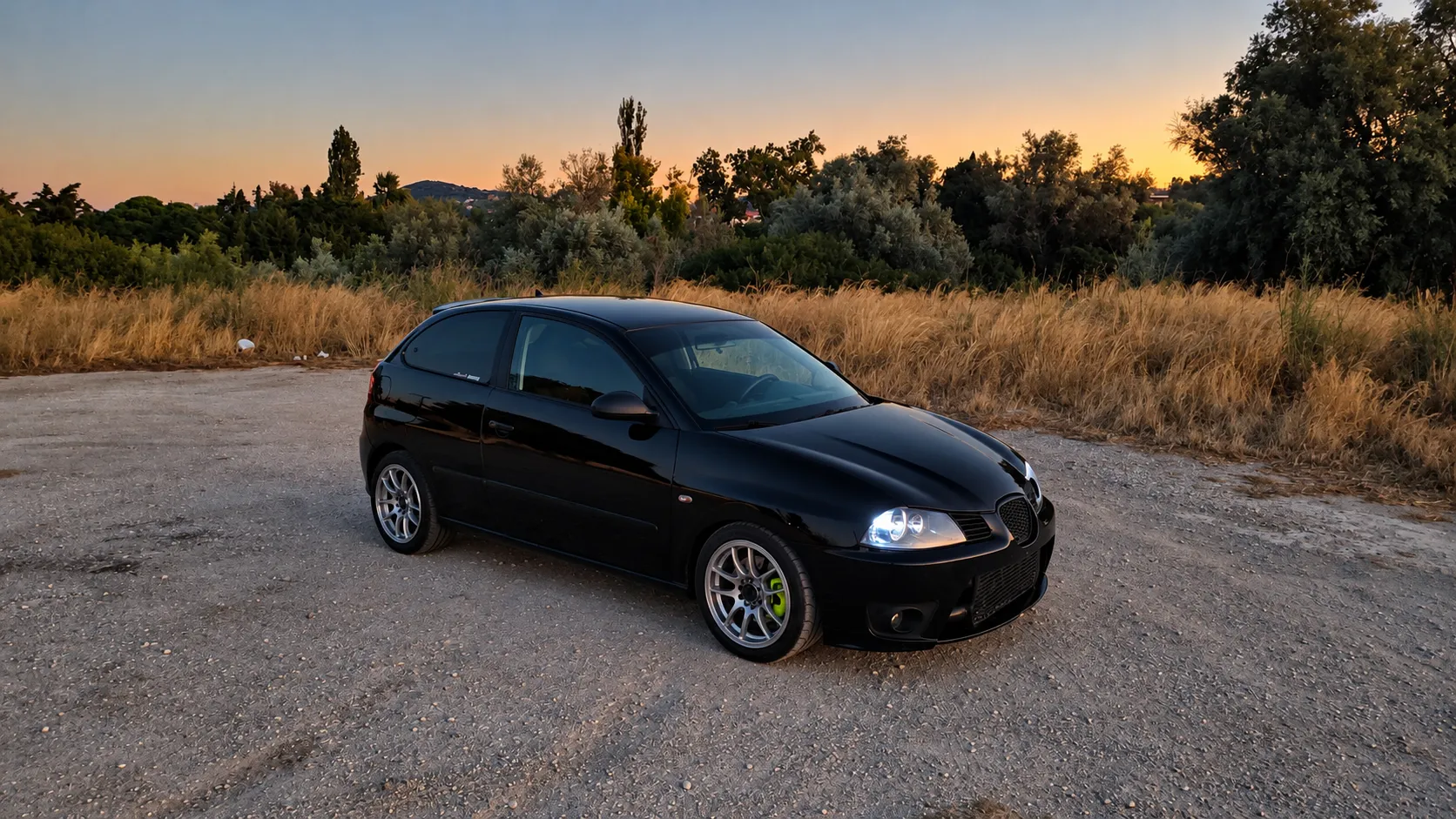
Visually, the Ibiza is surprisingly discreet considering what lies beneath its bonnet.
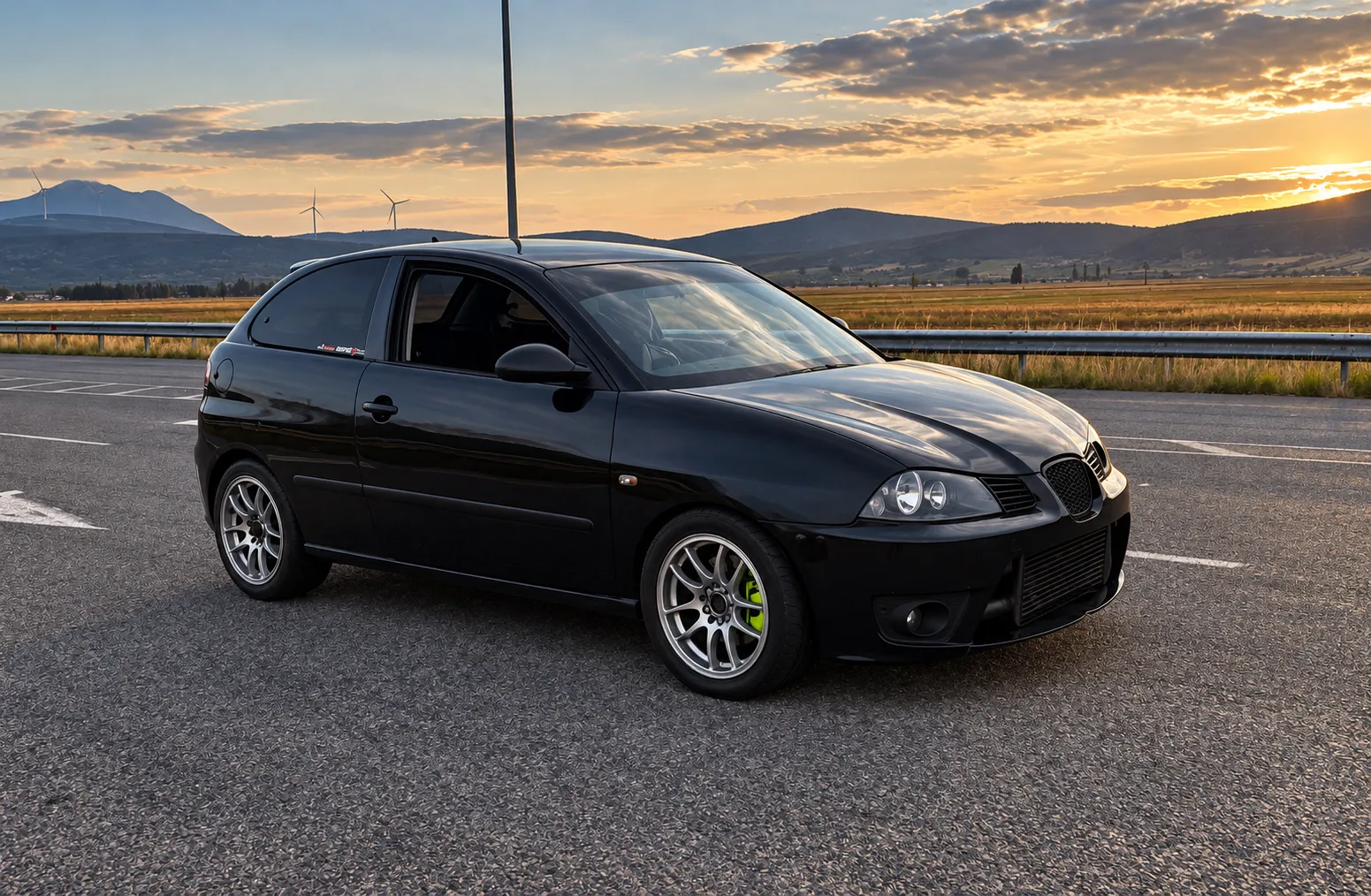
Finished entirely in black, it avoids flashy bodywork, oversized wings, or anything that would immediately reveal its performance capabilities. At first glance, it could easily be mistaken for a relatively ordinary modified hatchback.
Look a little closer, however, and a few details begin to tell a different story.
The driver’s side headlight features a dedicated opening that channels fresh, cold air directly towards the turbocharger’s intake. The front bumper has been opened up, leaving the massive intercooler completely exposed, although its black finish helps it blend into the car’s otherwise understated appearance. Then there are the wide front tyres, perhaps the most obvious indication that this Ibiza has considerably more power than its modest exterior suggests.
It’s a simple, purposeful look, with every noticeable modification serving a function rather than making a statement.
The Ibiza doesn’t go out of its way to look fast. It lets its performance take care of that.
A 1.8T Built for Serious Boost
At the heart of the Ibiza sits Volkswagen Group’s well-known 1.8T 20-valve engine, a platform that has earned its reputation throughout the European tuning community.
In this case, however, very little remains standard.
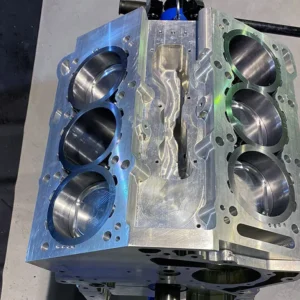
The bottom end has been extensively strengthened, beginning with oversized 81.5 mm DP forged pistons and forged MP H-beam connecting rods featuring 20 mm wrist pins. The original crankshaft has been retained, supported by ACL Racing main and connecting-rod bearings.
ARP head and main studs secure the assembly, while a pinned billet crankshaft timing gear provides additional security to the timing system. A TDI oil pump, NRG manual belt tensioner, and Gates timing belt complete the supporting hardware.
The cylinder head has received equally serious attention.
An ADR naturally aspirated 20-valve cylinder head forms the foundation, fitted with Ferrea valves oversized by 1 mm, Cat Cams valve springs and retainers, and custom Cat Cams camshafts featuring specially selected duration and lift profiles and adjustable cam timing hardware, including a Bartek timing gear. A combination of carefully selected parts that allows the engine’s characteristics to be optimised at extreme precission.
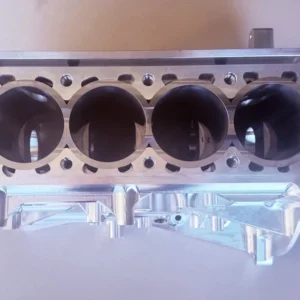
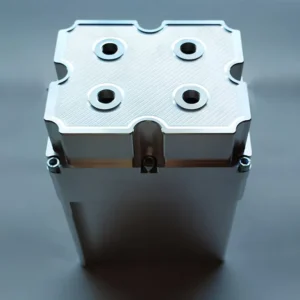
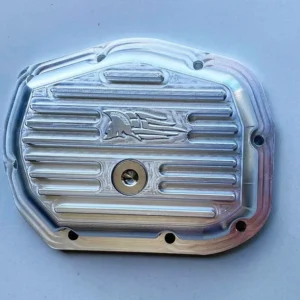
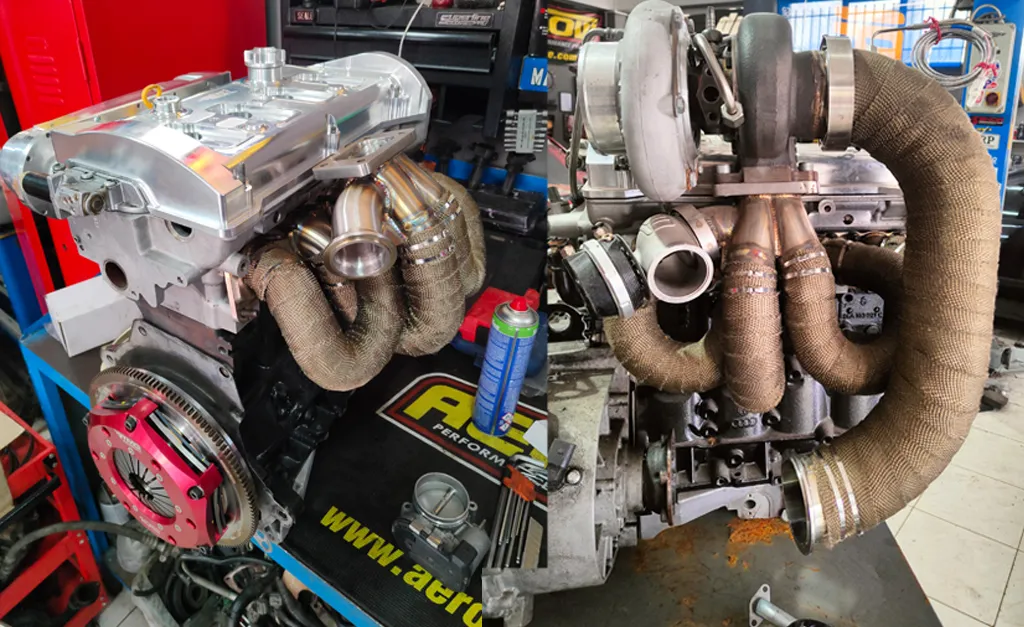
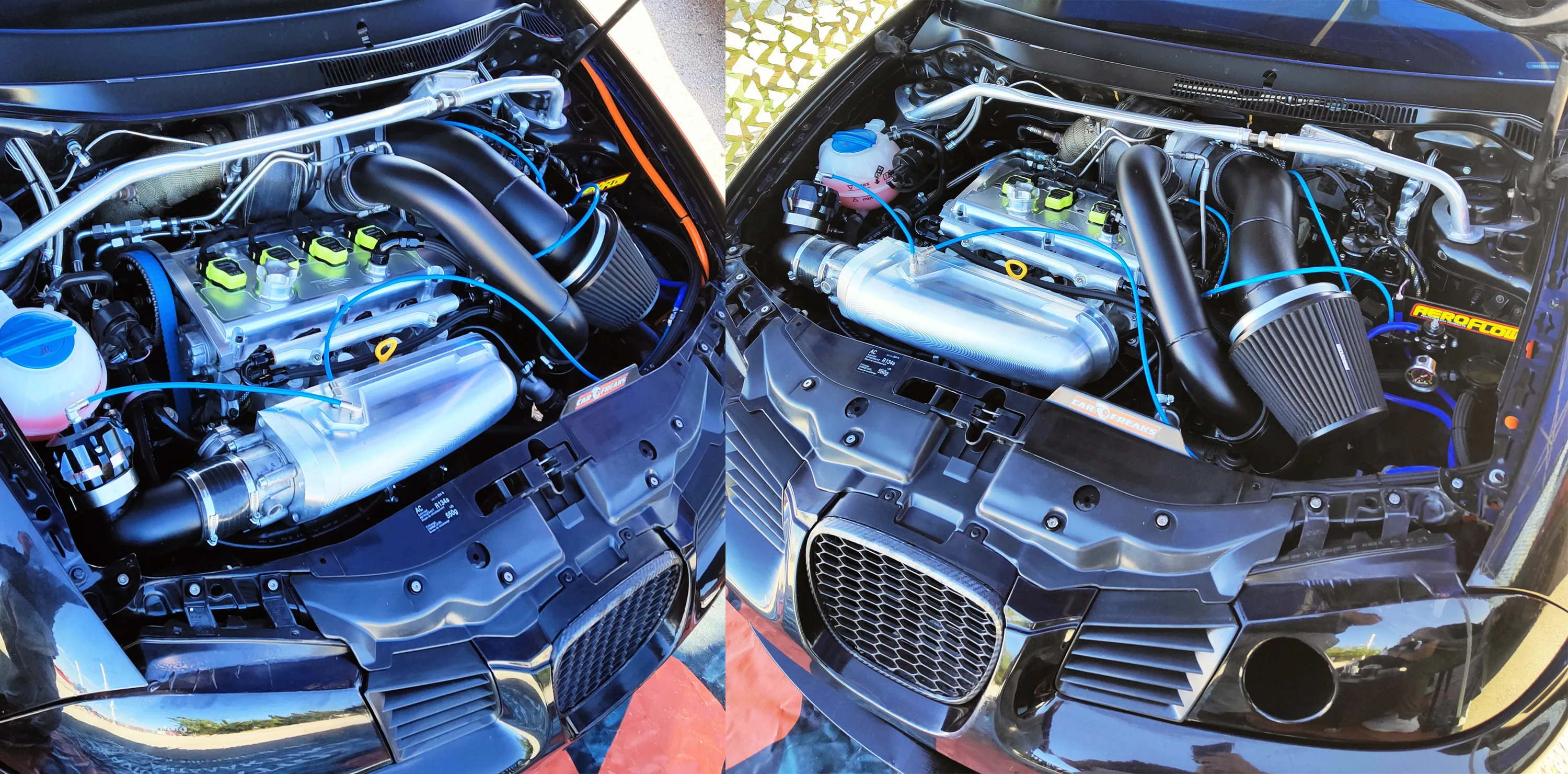
Completing the assembly is a custom billet valve cover manufactured by Kakarakis Performance, adding a distinctive finishing touch to an already impressive engine bay.
The objective behind this combination isn’t simply to achieve a particular horsepower figure. It’s to create a strong, capable engine with the mechanical foundation required to operate at substantial boost pressures while retaining room for further performance.
The Garrett Factor
Forced induction comes courtesy of a Garrett GTX3071 Gen 1 turbocharger with a custom billet compressor wheel, featuring a T3 0.82AR configuration and mounted to a custom 48 mm SS321 top mount, stainless-steel exhaust manifold manufactured by Kakarakis Performance.
A Turbosmart GenV 50 mm external wastegate handles boost regulation, while exhaust gases exit through a 90 mm V-band downpipe connected to a full 76 mm V-band exhaust system.
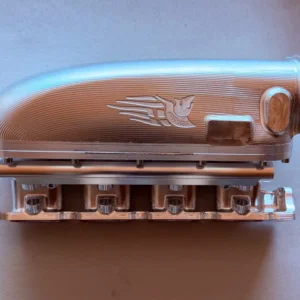
On the intake side, another custom Kakarakis Performance component takes centre stage: a billet aluminum intake manifold paired with a Bosch Motorsport 70 mm throttle body.
A huge custom front mount intercooler handles charge-air cooling, connected through ceramic coated aluminum piping with 70 mm intake and 76 mm feed dimensions.
An RTMG 50 mm blow-off valve manages pressure release, while an Aeroflow 100 mm air filter supplies the turbocharger with incoming air. Crankcase ventilation is managed through an Aeroflow three-way billet catch can.
It’s a comprehensive setup designed around efficient airflow, effective boost management, and the demands of high-output turbocharged performance.
The extensive custom fabrication also highlights the important role Kakarakis Performance played throughout the project, contributing far more than a collection of off-the-shelf components.
Fueling the Performance
With the engine and turbocharger capable of substantial airflow, the fuel system needed to be equally capable.
The Ibiza uses a multi-pump arrangement designed to provide a consistent fuel supply under demanding conditions.
A Walbro 255 L/h in-tank pump feeds a 3.8-litre Aeroflow surge tank. From there, two Aeroflow 340 L/h pumps supply fuel through a custom billet fuel rail manufactured by Kakarakis Performance.
Four FIC Bosch 1100xx injectors complete the system.
The surge tank arrangement is particularly relevant to a car intended for aggressive acceleration, helping maintain fuel availability during conditions where fuel movement inside the main tank could otherwise become a concern.
Once again, the approach reflects the philosophy behind the entire build: supporting systems are developed alongside the engine rather than treated as an afterthought.
Factory ECU, Custom Calibration
Despite the extensive mechanical modifications, the Ibiza continues to use its original engine management ECU.
Boost pressure is managed through a PRD700 boost controller, while additional sensors monitor oil pressure and temperature, air-fuel ratio, and fuel pressure and temperature.
Ignition duties are handled by DTM TFSI 40 kV coils.
The ECU calibration was carried out by DYNODROME, also known as Salias, whose work brings together the upgraded engine hardware, turbocharger, fuel system, and ignition components.
At this level of performance, calibration is essential not only for achieving power but also for controlling how that power is delivered.
And in a front-wheel-drive car, power delivery can be every bit as important as the final dyno figure.
However the owner told us that the next step on this build will be a standalone ecu, mostly in order to help with traction management, as this is the only limitation the oem ECU has at the moment.
Three Pedals, Six Gears, Two Driven Wheels
Perhaps the most interesting decision behind the entire project is the one George made before the build even began.
Regardless of the power eventually produced, the Ibiza would remain a front-wheel-drive car with a manual transmission.
An 02M six-speed FWD gearbox swap that came from the big brother Leon Cupra R provides the foundation, accompanied by a short-shift gear selector and an RTMG twin-plate clutch.
Upgraded bushings and billet engine and transmission mounts complete the drivetrain modifications.
It’s a choice that gives the car a very particular personality.
Modern high-performance builds frequently rely on sophisticated automatic transmissions or specialised drag-racing gearboxes to maximise acceleration and consistency. George, however, wanted to preserve the mechanical involvement that comes with selecting every gear himself!
That decision introduces additional challenges, particularly when transmitting several hundred horsepower through the front wheels.
But those challenges are part of the appeal.
The objective was never to create the easiest possible route to a fast quarter-mile time. It was to build a car that combined serious performance with the driving experience its owner enjoys.
Making the Most of Front-Wheel Drive
Producing 500 horsepower at the wheels is one achievement. Making effective use of it through a single driven axle is another.
To address the demands of the drivetrain, the Ibiza features custom four-link bars, upgraded bushings, and Koni Inox fully adjustable coilover suspension, everything carefully adjusted after many tests, in order to deliver the best launch start and traction possible.
The wheel and tyre combination reflects the car’s performance priorities.
Sixteen-inch by eight-inch drag wheels are fitted with 235/45 R16 semi-slick tyres at the front, providing a substantial contact patch for the driven wheels.
At the rear, narrower 205/45 R16 semi-slick tyres complete the setup.
The wider front tyres, adjustable suspension, and chassis modifications provide the basis for optimising traction and controlling weight transfer during hard acceleration.
Of course, front-wheel drive has its limitations, especially when substantial torque is involved.
But this build is about working with those limitations rather than abandoning the platform altogether.
The result is a chassis and drivetrain package developed specifically around the character of a powerful, lightweight, manually shifted FWD hatchback.
Less Weight, More Purpose
Inside the Ibiza, the focus on performance becomes immediately obvious.
There is no air conditioning, no audio system, and no passenger seating.
Only the driver’s seat remains.
The interior has undergone extensive weight reduction, with unnecessary equipment removed and carbon-fibre components incorporated throughout the project.
A carbon-fibre liftgate contributes further to the weight-saving effort, while the battery has been relocated to the rear of the car.
The result is a remarkably low vehicle weight of just 955 kilograms without the driver.
That figure is particularly impressive considering the substantial turbocharging hardware, strengthened drivetrain, and supporting systems required by the engine.
For George, the stripped interior is not simply about reducing a number on a scale. It’s about improving the overall performance package.
Less mass means less weight to accelerate, brake, and control.
And when a car already produces 500 horsepower at the wheels, every kilogram matters.
500 WHP — And Plenty in Reserve
Now for the numbers.
At 2.0 bar of boost pressure, running on 100-octane pump gasoline, the Ibiza produces 500 horsepower and 48 kgm of torque at the wheels.
Combined with its 955-kilogram weight, this translates to approximately 524 wheel horsepower per tonne.
For a front-wheel-drive hatchback equipped with a conventional six-speed manual gearbox, that’s a particularly impressive power-to-weight ratio.
But the engine’s capabilities extend considerably further.
The fully built 1.8T can operate at boost pressures of up to 3.2 bar, using 100-octane gasoline combined with methanol.
According to the build’s specifications, the turbocharger and engine combination has a stated potential approaching 850 wheel horsepower, although that figure should not be confused with a confirmed measured output.
The actual horsepower and torque figures at the higher boost setting remain undisclosed.
Interestingly, George’s decision to keep those numbers private isn’t about creating mystery around the car.
His reasoning is much simpler.
He’s confident that the 500 WHP available at just 2.0 bar will already be enough to outperform most of the rivals he expects to encounter.
For that reason, he sees little need to focus attention on the maximum figures when the lower-boost configuration already provides such a capable performance package.
It’s also a sensible approach from a practical perspective. In a lightweight front-wheel-drive car, managing traction and making effective use of the available power can be more important than adding another hundred horsepower to the dyno sheet.
The additional boost capability remains available, but it doesn’t necessarily need to be used to achieve the car’s intended goals.
If needed, its just one click away…
That philosophy says a great deal about the project.
The aim isn’t simply to build the most powerful Ibiza possible.
It’s to build an Ibiza that performs exactly as its owner wants it to.
A Greek Project Built Through Collaboration
Although George’s vision shaped the project from the beginning, bringing it to life required the involvement of several experienced specialists.
The build was carried out at Zaxariou Autotuning in Liosia, Greece, where the car underwent its extensive mechanical transformation from the hands of Christos Zaxariou.
Kakarakis Performance played a major role in the project, providing technical involvement and manufacturing several important custom components, including the exhaust manifold, billet intake manifold, fuel rail, and valve cover.
DYNODROME’s Salias was responsible for the ECU calibration, ensuring that the engine’s extensive hardware modifications worked together as a complete package.
The collaboration demonstrates what can be achieved when a clear objective is supported by the right combination of experience, fabrication, and tuning knowledge.
It’s also an example of the engineering creativity found within the Greek performance-car community, where relatively modest production platforms can become the foundation for highly specialised builds.
More Than a Horsepower Figure
What makes this SEAT Ibiza particularly interesting isn’t simply its engine specification or the amount of boost it can produce.
It’s the consistency of the idea behind it.
From the forged 1.8T engine and custom turbo system to the six-speed manual gearbox, lightweight interior, and carefully selected chassis components, every major modification supports the same objective.
George wanted an uncompromising front-wheel-drive street car that would retain the involvement of a manual gearbox while delivering performance capable of challenging much more powerful machinery.
With 500 WHP already available at 2.0 bar, a weight of just 955 kilograms, and considerable additional potential in reserve, the Ibiza has the hardware to make that ambition a serious proposition.
Whether it eventually spends more time on the street or makes occasional appearances at the drag strip, the underlying philosophy remains unchanged.
It was built to be driven, enjoyed, and tested against the competition — not simply admired for its specifications.
And perhaps that’s the best way to describe this Ibiza: a car built with far more potential than its owner believes he’ll actually need.
TECHNICAL SPECIFICATIONS
Vehicle: SEAT Ibiza 1.8T 20V FWD
Owner: George — Car Freaks GR
Builder: Zaxariou Autotuning, Liosia, Greece
Custom fabrication: Kakarakis Performance
ECU calibration: DYNODROME / Salias
Engine & Cylinder Head
- 1.8T 20V engine
- DP 81.5 mm oversized custom forged pistons
- MP forged H-beam connecting rods, 20 mm pins
- OEM crankshaft
- ARP head and main studs
- ACL Racing main and rod bearings
- Pinned billet crank timing gear
- TDI oil pump
- NRG manual timing-belt tensioner
- Gates timing belt
- ADR naturally aspirated cylinder head
- Ferrea +1 mm valves
- Cat Cams valve springs and retainers
- Custom Cat Cams duration/lift camshafts
- Adjustable inner cam gears,
- Bartek adjustable outter cam gear
- Kakarakis Performance billet valve cover
Turbo & Intake
- Garrett GTX3071 Gen 1 T3 turbocharger
- Turbosmart GenV 50 mm external wastegate
- Kakarakis Performance 48mm SS321 T3 exhaust manifold
- 90 mm V-band downpipe
- Full 76 mm V-band exhaust system
- Kakarakis Performance billet intake manifold
- Bosch Motorsport 70 mm throttle body
- FM custom intercooler
- 70 mm intake / 76 mm feed aluminum piping + ceramic coating
- RTMG 50 mm blow-off valve
- Aeroflow 100 mm air filter
- Aeroflow three-way billet catch can
Fuel System
- Walbro 255 L/h in-tank pump
- Aeroflow 3.8-litre surge tank
- 2 × Aeroflow 340 L/h fuel pumps
- Kakarakis Performance billet fuel rail
- 4 × FIC Bosch 1100xx injectors
Engine Management & Ignition
- OEM ECU
- PRD700 boost controller with CAN and additional sensors
- Additional oil pressure/temperature sensors
- Additional AFR sensor
- Additional fuel pressure/temperature sensors
- DTM TFSI 40 kV ignition coils
- ECU calibration by DYNODROME / Salias
Transmission & Suspension
- 02M six-speed FWD manual transmission swap
- Short-shift gear selector
- RTMG twin-plate clutch
- Upgraded bushings
- Billet engine and transmission mounts
- Custom four-link bars
- Koni Inox fully adjustable coilover suspension
Wheels & Tyres
- 16 × 8-inch drag wheels
- Front: 235/45 R16 semi-slick tyres
- Rear: 205/45 R16 semi-slick tyres
Interior & Weight Reduction
- Driver’s seat only
- Air conditioning/Heater removed
- Audio system removed
- Extensive weight reduction
- Carbon-fibre components
- Carbon-fibre liftgate
- Battery relocated to the rear
Performance
- Confirmed output: 500 WHP
- Confirmed wheel torque: 48 kgm
- Confirmed boost setting: 2.0 bar
- Fuel: 100 RON pump gasoline
- Higher boost setting: up to 3.2 bar
- Higher-boost fuel: 100 RON gasoline + 4port methanol
- Higher-boost power/torque: Not publicly disclosed
- Stated build potential: Up to approximately 850 WHP
- Vehicle weight: 955 kg without driver
- Power-to-weight ratio at 500 WHP: Approximately 524 WHP/tonne